

Preimplantation genetic testing for chromosomal aneuploidy (PGT-A)
Advanced embryo screening for numerical chromosomal abnormalities.
Explore PGT-A
PGT-A, PGT-SR and PGT-M for the identification of chromosomal abnormalities and monogenic diseases in embryos.
Couples who are carriers of an inherited genetic disorder or a chromosomal abnormality face an increased reproductive risk, as these conditions may be transmitted to their children. In such circumstances, prenatal diagnosis by chorionic villus sampling (CVS) or amniocentesis may be used to determine whether the fetus is affected by a genetic or chromosomal condition.
While these procedures are now well established in clinical practice, the diagnosis of an affected fetus may place couples in the difficult position of having to decide whether to continue the pregnancy or proceed with therapeutic termination.
The evolution of in vitro fertilization (IVF) techniques, together with the possibility of obtaining embryonic cells suitable for genetic analysis, has significantly expanded the scope of reproductive genetics. It is now possible to move genetic diagnosis from the post-implantation stage to the preimplantation stage, allowing clinically relevant information to be obtained before pregnancy is established.
Within this context, Preimplantation Genetic Testing (PGT) represents a valuable procedure complementary to prenatal diagnosis. It enables the identification of genetic disorders and chromosomal abnormalities in embryos generated in vitro from couples at increased reproductive risk, at the earliest stages of development and prior to uterine transfer.
PGT therefore supports more informed reproductive choices and reduces the likelihood of facing therapeutic termination of pregnancy, an event that is often deeply burdensome from a psychological perspective and not always acceptable on ethical or moral grounds.
Advanced embryo screening for numerical chromosomal abnormalities.
Explore PGT-A
Advanced embryo assessment for carriers of balanced chromosomal rearrangements.
Explore PGT-SR
Family-specific embryo testing for known inherited single-gene disorders.
Explore PGT-M
Non-invasive PGT through analysis of cell-free embryonic DNA in spent culture medium. A non-invasive approach to embryo prioritization based on chromosomal copy-number assessment.

Genomic Preimplantation Genetic Testing. The first preimplantation genetic test that screens the whole exome of IVF embryos.
| Test | Clinical indications | Clinical purpose | Key benefits |
|---|---|---|---|
| PGTADVANCE-M | Couples who are carriers of inherited genetic disorders | To identify embryos unaffected by the specific familial genetic disorder under investigation | Reduces the risk of transferring embryos affected by inherited genetic disease |
| PGTADVANCE-SR | Couples who are carriers of balanced chromosomal rearrangements | To identify embryos free from chromosomal imbalances arising from the parental rearrangement | Reduces the risk of transferring embryos with unbalanced structural chromosomal abnormalities |
| PGTADVANCE-A |
| To identify embryos free from numerical chromosomal abnormalities (aneuploidies) |
|
| EMBRYOGENOME |
| To identify genetic and chromosomal abnormalities that may not be detected by conventional PGT approaches, providing an unprecedented level of diagnostic insight in embryo screening |
|
| EMBRYOADVANCE | Patients seeking to improve their chances of pregnancy within an IVF pathway without resorting to invasive procedures such as embryo biopsy | To identify, in a non-invasive manner, embryos with a higher probability of euploidy and, therefore, greater implantation potential |
|
Couples who are carriers of inherited genetic disorders
To identify embryos unaffected by the specific familial genetic disorder under investigation.
Reduces the risk of transferring embryos affected by inherited genetic disease
Couples who are carriers of balanced chromosomal rearrangements
To identify embryos free from chromosomal imbalances arising from the parental rearrangement.
Reduces the risk of transferring embryos with unbalanced structural chromosomal abnormalities
To identify embryos free from numerical chromosomal abnormalities (aneuploidies)
To identify genetic and chromosomal abnormalities that may not be detected by conventional PGT approaches, providing an unprecedented level of diagnostic insight in embryo screening
Patients seeking to improve their chances of pregnancy within an IVF pathway without resorting to invasive procedures such as embryo biopsy
To identify, in a non-invasive manner, embryos with a higher probability of euploidy and, therefore, greater implantation potential
PGT combines in vitro fertilization (IVF) techniques with the most advanced applications of molecular genetics, providing a sophisticated approach to embryo genetic assessment before transfer.
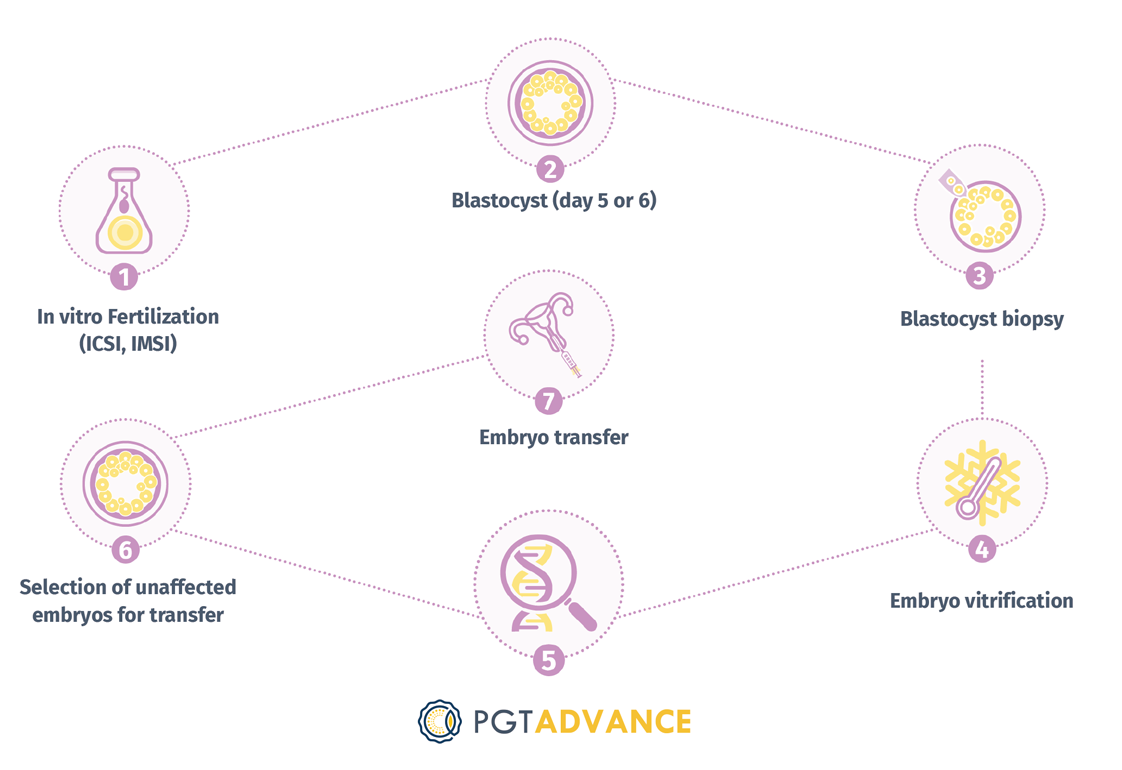
The process begins with a medically assisted reproduction treatment cycle (1), aimed at retrieving oocytes, which are then fertilized with paternal sperm to generate embryos in vitro. Once the embryos reach the blastocyst stage (2), they undergo trophectoderm biopsy (3), a procedure that allows a small number of embryonic cells to be collected for genetic analysis. The embryos are subsequently cryopreserved (4) while awaiting the test results. The DNA from each embryo is then analyzed using the PGT approach (5). Embryos found to be unaffected by the specific genetic condition under investigation are subsequently selected (6) for uterine transfer (7), with the aim of achieving a pregnancy unaffected by the disorder being tested.
PGTAdvance combines chromosomal copy-number assessment and genetic marker analysis with bioinformatic tools designed to strengthen result interpretation.
Clinical and genetic documentation is reviewed for feasibility and case planning (PGT-M and PGT-SR only).
Where appropriate, patients are offered specialist counseling regarding indication, workflow, and testing strategy.
A formal testing plan is issued to the referring clinic. For PGT-M, this includes any assay development requirements.
For PGT-M, a family-specific assay is designed and validated based on the identified pathogenic variant(s). A formal work-up report is then issued to the clinic.
Embryos are generated through IVF and trophectoderm biopsy is performed at the blastocyst stage.
Embryo biopsy samples are transported to GENOMICA under validated shipping conditions.
Embryonic DNA is analyzed using the relevant PGTAdvance workflow and a formal genetic report is issued to the IVF team.
Embryos classified as unaffected, normal or balanced, or euploid, as applicable, may be considered for transfer according to the clinical treatment plan.
GENOMICA builds upon the collective expertise of specialists with more than 25 years of experience in preimplantation genetic testing, combining established scientific knowledge with advanced molecular technologies to support accurate and clinically meaningful embryo assessment.
This longstanding commitment reflects a continuous dedication to innovation in reproductive genetics and to the ongoing refinement of PGT methodologies for clinical practice.
Improved genome coverage, optimized analytical workflows, and case-specific assay design contribute to highly reliable PGT results and increased confidence in embryo classification.
Through the integration of advanced laboratory methodologies, specialist clinical interpretation, and individualized case management, GENOMICA delivers a high standard of service for both clinicians and patients.
Genomica's commitment includes:

Excellence in Reproductive Genetics
GENOMICA is a highly specialized diagnostic laboratory and a recognized center of excellence in reproductive genetics, active in both clinical diagnostics and scientific research. Supported by a team with more than 25 years of experience in molecular diagnostics, GENOMICA combines scientific expertise, advanced technology, and a strong commitment to continuous innovation to provide high-quality reproductive genetic services to IVF clinics worldwide.
With genetic counselors expert in discussing genetic test results and familial risks.
Fast and reliable reporting to support clinical decision-making.
Quality management and validated laboratory procedures.
Laboratories with advanced technologies and high quality standards.
A research team focused on innovation in reproductive genetics.
High-volume diagnostic experience and consolidated expertise.
Download our brochures to explore the full PGTAdvance portfolio and learn more about each of the three tests.
Fill out the form for a free consultation. One of our geneticists will contact you, with no obligation, to provide all the information you need about the PGTAdvance test.